Views and opinions expressed on this blog are solely my own and do not reflect views of any organizations or employers with whom I am affiliated.

Sunday, April 13, 2014

Bankrupt Companies and their Employees: Conscious Uncoupling


I know, the phrase "conscious uncoupling" is extremely trite by now, but even The Economist joined in on the joke, so I thought, "why not"? Plus, it's actually relevant to this post, I promise.

Brookstone, a specialty retailer of luxury gadgets like massage chairs, has filed for bankruptcy with a deal to sell its assets to Spenser Spirit. The retailer has been cutting costs for a while, however, and it appears that many of the personnel cuts have happened prior to the announcement.

"Jim Speltz, Brookstone president and CEO, said the deal would have no impact on customers, that "business will continue uninterrupted," and that all existing customer programs, including warranties, gift cards, returns and exchanges, would be honored.

The company also plans to maintain employee benefit and payroll as they currently exist, he said. Brookstone's largest creditors support the deal to salvage the retailer that has seen declining sales in recent years." NH Union Leader

Not only are the current employees being retained, but Brookstone is handing out large bonuses to some of its management team. 

"Under the proposal, four executives would earn bonuses tied to the sale price as well as the company’s cash flow. For example, if Brookstone closes the $147 million deal currently on the table, then the executives would share roughly $840,000 in bonuses, although this doesn't take the cash-flow targets into account.

Another 33 non-executive employees would share up to $1.28 million in bonuses as long as they stick with Brookstone throughout the sale process. These employees come from the company’s finance, e-commerce, human resources and other departments." WSJ Bankruptcy Beat

It looks like Brookstone is doing a decent job of transitioning its employees, which is not always the case for companies in distressed situations. Not having an acceptable transition period for the employees could impact shareholders or even sponsor private equity firms!


The WARN Act, which was codified in 1998, gives guidance for lay-offs for both healthy and stressed companies. 


"The WARN Act "provides that a business enterprise that employs 100 or more employees must provide at least 60 days advance written notice of any “plant closing” or “mass lay-off” to each employee who will be terminated.  A “plant closing” is a shutdown (permanent or temporary) that results in the loss of employment of 50 or more full-time employees at a single site of employment.  A “mass layoff” is the loss of employment of 500 or more people or the loss of employment of at least 50 employees constituting more than 33 percent of the full-time employees at a single employment site." JD Supra


Although employers must still provide notice as soon as practicable, there are three stated defenses to the 60 day notice requirement under the WARN Act:
  1. "when an employer reasonably believes that advance notice would impede its active pursuit of capital or business;
  2. unforeseeable business circumstances; and
  3. natural disasters.
Somewhat naturally, companies seeking bankruptcy protection are often forced to abruptly terminate employees before providing the required notice.   In addition to developing the “liquidating fiduciary” principal discussed above, bankruptcy courts have examined, and often disagreed, about certain applications of the WARN Act once the “employer” is bankrupt."  JD Supra

When a company lays off workers in turbulent times, the second defense of the WARN Act may apply, in which case, the company may not have liability under the Act. However, it gets interesting if that company is owned by a private equity sponsor.

In 2000, Outboard Marine Corporation, a designer and manufacturer of outboard motors, filed for Chapter 11 protection and laid off 6,500 employees without notice. Employees filed a class action lawsuit (Vogt case) alleging violation of the WARN Act. However, since Outboard had limited assets, the plaintiffs sued the three private equity firms, Greenmarine Holdings, Quantum Industrial Partners and Quantum Industrial Holdings, along with entities that owned interest in those firms. Goodwin Proctor.

The court determined that those three private equity firms and Outboard constituted a single owner since majority of the shares and board seats were held by those private equity firms.

"The Court focused on the fact that the defendants were heavily involved in the preparations for Outboard’s bankruptcy and ultimately made the decision to file for bankruptcy and close the company’s facilities. The Court concluded that these allegations supported the plaintiffs’ contention that the three private equity firms acted as a single employer and thus could be held liable for Outboard’s failure to comply with the notice requirements of WARN." Goodwin Proctor.

When we think of distressed private equity firms instituting a turnaround of their portfolio companies, lay-offs and closings can be part and parcel of the reorganization. When implementing a personnel restructuring, sponsors need to balance being transparent about cuts and avoiding operational distractions. Moreover, restructuring professionals advising a company in distress ought to tread lightly and make sure that all of the boxes are checked when recommending downsizing. In order to avoid liability under the WARN Act, and even more importantly, to treat employees in a decent manner, a "conscious uncoupling" is crucial. 

Monday, April 7, 2014

Comedy in Tragedy: The Daily Show on GM Liabilities


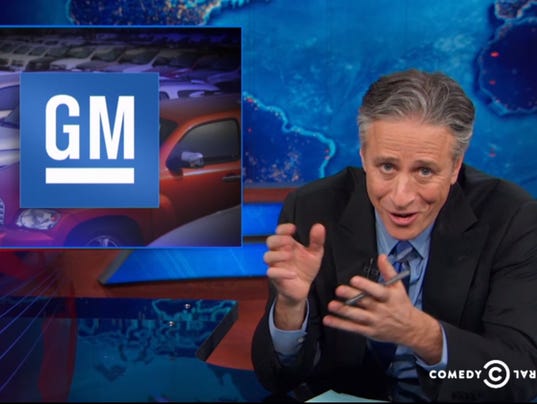
I LOVE The Daily Show. Last week, Jon Stewart discussed how the post-bankruptcy GM is immune from liabilities related to accidents caused by vehicles made by pre-bankruptcy GM. The automaker's fledgling CEO Mary Bara led the recall of approximately 2.6 million vehicles with faulty ignition switches. This defect is linked to at least 13 deaths, which is especially controversial because GM has known about this since 2005. The automaker purportedly decided against fixing the problem then because it would take too long and cost too much money (WSJ). 


Let's recall a teeny tiny fact about the time-frame of the initial discovery of the ignition issue: the GM and Ford downgrade from Investment Grade to High Yield! Remember that mess in 2005? GM and Ford, which were considered bellwether bonds making up the second and third largest issuers of the bond market. This was right after the Fed had raised short-term rates and GM had failed to get healthcare concessions from its unions. 

"The GM downgrade could cause disruptions in the market for junk bonds, partially because many funds that are limited to investment-grade assets will be forced to sell GM's bonds." WSJ

So cost of capital for GM went from around 5% to around 11% for corporate debt. There was a huge sell-off in the bond market and then Kerkorian started bidding for GM stock, which had languished from $40 in the beginning of 2005, at $31. 

I'm sure that GM management at the time was like, "Eh. We have to pay more than double to borrow money, our unions want way more in healthcare benefits than we can afford, and, oh, we may now have an activist shareholder hovering over our shoulders. We're selling a record number of vehicles because we started this vicious employee discount cycle to offset our dwindling market share, and we need to keep selling. Let's hold off on making changes to this ignition thing until we're super duper sure about what we're going to do." Not that it absolves anyone of wrongdoing, but it gives us some context as to the turbid morass that the company was in at the time. 


Okay, so let's get to the liabilities from ignition device defects, why, according to bankruptcy law, new GM doesn't necessarily have a legal obligation to compensate consumers for the malfunctions, and what can possibly be done about it. 

When I heard Stewart talk about GM negotiating the release of former liabilities as part of its bankruptcy plan, he made it sound as if such releases are abnormal. In fact, a Chapter 11 filing is puissant precisely because it gives the company a new life line by extricating itself, at least partially, of the heavy burdens of debt and liabilities. If you'd like to know more about the history and impact of liabilities releases on financial renewal in America, check out this ABI podcast with Harvey Miller.

When a corporation files for bankruptcy protection, a reorganization plan, which has to be approved by the judge, details recuperation of the company's assets for all stakeholders. BUT, all stakeholders aren't created equally. For example, in GM's case, if a bank lends specifically for the a new plant and the plant serves as collateral, more than likely, in a simplified case, the bank will get that plant in a bankruptcy filing. This arrangement makes the bank a secured lender. 

Then, there are unsecured lenders, those who lend to GM without having explicit collateral. There are many levels of unsecured lenders, which can get kind of complicated. But the process of a restructuring involves figuring out which lender has dibs on which assets, and then distributing those assets accordingly. 

Obviously, consumers of the product can also have claims in a bankruptcy proceeding, especially in cases such as warranties, gift certificates or pre-orders. So what happens in the case where stakeholders at the time of the bankruptcy don't know they're going to have claims? That is, they didn't know they had a faulty switch until now in a car that was purchased back before the bankruptcy filing? There is precedence for such a situation in the Epstein v. Official Committee of Unsecured Estate of Piper Aircraft. Here's a quick summary: 

"Piper has been manufacturing and distributing general aviation aircraft and spare parts throughout the United States and abroad since 1937.

On July 1, 1991, Piper filed a voluntary petition under Chapter 11 of Bankruptcy Code in the United States Bankruptcy Court for the Southern District of Florida. Piper's plan of reorganization contemplated finding a purchaser of substantially all of its assets or obtaining investments from outside sources, with the proceeds of such transactions serving to fund distributions to creditors.

On July 12, 1993, Epstein filed a proof of claim on behalf of the Future Claimants in the approximate amount of $100,000,000. The claim was based on statistical assumptions regarding the number of persons likely to suffer, after the confirmation of a reorganization plan, personal injury or property damage caused by Piper's pre-confirmation manufacture, sale, design, distribution or support of aircraft and spare parts." 58 F. 3d 1537

The most relevant aspect of this case decision is that these Future Claimants are considered tort victims. The problem is that tort claims do not take priority over secured claims, meaning that they're in the same category as unsecured claims. LexisNexis

So, let's do a simplified hypothetical example. The bank lends GM $80 for the plant. Then, GM issues unsecured bonds that get purchased by mutual funds and insurance agencies with a notional amount of $100. Total GM debt is $180. GM files for bankruptcy and sells its plant and other assets for $100. Of that amount, $80 goes to the bank because it was a secured lender. There's only $20 left over for ALL unsecured bondholders plus any future claimants of tort cases. The trustee sets aside $10 for future claimants and distributes $10 to the rest of the unsecured holders. 

A few years later, it turns out that there are $100 of tort cases related to pre-petition design of cars. New GM pays off those victims in full. What happens? If you held an unsecured bond and 10 got cents on the dollar, you'd be pretty upset since the tort victims, whose claims were at the same level as yours, got more than you did. 

The problem here is deeper than it initially seems. If we assume that future tort victims have similar priority as unsecured claimants, then we can't justly pay them more. We also can't require the new GM to compensate the tort victims because that would be changing the rules after the deal has been done. That is, since the new GM has different shareholders, the new shareholders bought the stock assuming that they weren't liable for future claimants any more than for unsecured bondholders. Changing that would cause buyers to lose trust in the system. (Here's a Pepper Hamilton article for more). 

The current law obviously isn't the answer, however. Loyola University's Law Journal describes the issue in more detail: 

"Allowing the debtor to escape liability for wrongful prepetition conduct frustrates the goal of deterring wrongful conduct by the debtor and others in the future. Under Piper, a tortfeasor may escape financial responsibility by simply filing for the protection of the bankruptcy court."

Is there a solution? There have been many offered in the legal field. Future damages that result from pre-petition issues could be considered claims in the bankruptcy court. There can be a cap on those claims and the judge can decide on a case-by-case basis. 

Another solution may be to put an actual dollar amount estimate to future claims and considering them secured debt so that they receive a portion of what's due to the secured guys. Here, the secured debtors end up paying for the victims (you know, the lender for the plant). 

Another answer could be explicitly requiring the new shareholders to pay for the mistakes of the old GM, maybe with a cap, so that the new shareholders know what to expect. 

Lastly, there could possibly be a claw-back using the fraudulent conveyance argument from previous shareholders, which may be the most fair, but also the most difficult to prove and execute. 

See Mr. Stewart, the problem here isn't simply a matter of whether or not the injured ought to be compensated; it's a problem of who pays for it and ensuring that the decision is the most just solution available. 


Wednesday, April 2, 2014

'Amend and Pretend' or 'Fake it 'till you Make it'?


It seems as if any time companies aren't defaulting in droves, they are "amending and pretending". That is, companies renegotiate covenants and borrowing terms with their lenders to obviate a technical default that would lead to a larger restructuring. 

The Wall Street Journal's Bankruptcy Beat Blog has a new section in which bankruptcy and restructuring professionals opine on a chosen topic. The first one question proffered to the experts was essentially: isn't corporate restructuring on life-support because of low interest rates and maturities being pushed out to 2017 and 2018? I'd encourage you to read the post and the contributors' assessments because they provide a panoply of viewpoints on the matter. You can read all the posts here.

Many argue that companies issuing high yield bonds or leveraged loans have too much debt, and they can only service the debt because lower rates result in low cash interest expense. If you read LCD, you'll see the data corroborating this hypothesis. For example, even with lower rates and higher prices for syndicated leveraged loans, much of the new issuance is "covenant-lite", meaning the credit agreements lack financial metrics that companies must meet at certain intervals. The prevalence of cov-lite loans, along with low rates, was identified as one of the drivers of over-levered corporations. LCD points out, however, that the supply of cov-lite loans as a percent of the loan market is higher now than it was in 2007. Additionally, a greater percent of the loan market is rated CCC now than in 2007.


Continuing on this theme, LCD tweeted this chart that contends that debt/EBITDA ratios of companies in the leveraged finance market are creeping up to 2008 levels. 

So what does this mean for the health of the highly leveraged companies? Does easy financing and higher debt load necessarily mean that we're going to see higher defaults in the future? 

On an aggregate, yes, we should see higher defaults when rates rise. But when it comes to investing, there are those firms that use leverage well, and there are those firms who use it frivolously. I firmly believe in the corporate finance theory of having debt as a way to reduce mismanagement of capital, assuming that managers are accountable for servicing the debt.  

If the debt is used for organic growth via research or capital expenditures, then the extra flexibility that comes with cov-lite loans and low rates may be a way for companies to "fake it 'till they make it", emphasis being on "make it". As a lender, I'd want to see not only free cash flow metrics and ability to service debt, but also reduction of superfluous costs, a strong market strategy, and investment in top-line growth. 

Bank of America Merrill Lynch's High Yield Strategist Michael Contopoulos recently published a report on cap-ex and M&A spending. Here's more:

"Although leverage has increased since the financial crisis, high yield companies today have the highest interest coverage ratios since the beginning of our dataset (1998) and overall leverage is well below the early part of the decade. Additionally, gross margins remain well above pre-crisis levels as the increase in COGS since the financial crisis has been matched by revenue growth...

In absolute terms, capex increased on a yoy basis between 2010 and 2012 as cash balances were drawn down and debt loads increased. High yield CEOs funded capex despite low revenue, using debt as the main financing tool to achieve organic growth. It seems to us, however, that with little return on their investment, we may be seeing a shift in sentiment, as capex spending has decreased and more cash is being layered onto the balance sheet. This is a bad sign for future in-house investment, but we think is a very bullish sign for M&A. CEOs are likely shifting strategies after realizing 2 years of capex funding has done little to improve revenue, and as such, will seek other strategies, namely acquisitions, to increase earnings." BAML

He included the following graphs below to show that high yield companies have more cash on their balance sheets than in 2007, but they aren't using it to for cap-ex just yet.

So are these companies amending and pretending or faking it for the time being? I am less optimistic about cash balances and debt being used for acquisitions than for cap-ex because transaction and integration costs could easily put a strain on liquidity. High interest coverage is fleeting if you acquire a company with lower EBITDA and spend too much cash on the acquisition. 

For companies that haven't made much progress internally to have leaner cost structures and organic growth, I think they're amending and pretending with the extension of terms. For companies who have cleaned up their cost structures and are awaiting the fruits of internal investments, I think they'll come out stronger with help of the easy financing, even when rates rise. 

Tuesday, April 1, 2014

Sick Hospitals


With all of the changes in the American healthcare industry, there are bound to be some casualties (pun intended). Becker's, which is my favorite resource for everything healthcare related, had an article yesterday listing the seven acute-care hospitals and health systems that have filed for bankruptcy protection or announced their closure in the first quarter of 2014. You can read the full article here.

Becker's also uses the MedPAC report to outline some of the signs of a beleaguered hospital, which includes qualitative and quantitative measures, such as low occupancy rate and a high readmission rate.

So what can be done for the troubled hospitals? The first step obviously has to be operational and financial restructuring. Working alongside lenders and banks, the hospitals can come up with terms that are manageable to the debtor and acceptable to the creditor.

Operational improvement can come from many different areas. Proper management of working capital can unlock a great deal of value. A good billing company may be able to save money by filing claims properly to expedite reimbursements from insurance companies. Moreover, it can be helpful to forecast scenarios with various levels of reimbursement rates to come up with a payables strategy. If there is a way to match payables timing with reimbursement timing, that would be ideal. Working with vendors and maybe even consolidating them or using intermediaries can go a long way in managing payables.

M&A is also a good way of keeping health systems alive since a larger entity can have more leverage with the payers, vendors and staff. Here's more:

"Although Mr. Beith (of Crain Brothers & Company) says the number of healthcare organizations that fit the profile of troubled hospitals that face an "inevitable transaction" has declined as more consolidation occurs, the market is still "fairly robust" for smaller hospitals with big financial problems. He says more aggressive buyers such as Ontario, Calif.-based Prime Healthcare Services are still willing to take on troubled facilities.
"We still see a reasonable three- to five-year runway of significant merger and acquisition activity," Mr. Beith says. "We'll continue to see financially stressed hospitals pursue transactions."
Michael Lane, a managing director with Hammond Hanlon Camp, predicts troubled hospital sales will actually pick up as merger and acquisition activity in general continues at a rapid pace and more independent hospitals realize they can't survive on their own.
Additionally, he says he has observed some of the "big guys" in the hospital industry still see strategic value in acquiring a struggling facility that they can rehabilitate with the right management, expertise and oversight. 'There are some strategic opportunities the smart acquirers don't shy away from, as larger health systems look to grow in size and expand their market areas,' he says." Becker's
Lastly, filing for bankruptcy, especially a pre-pack, may be desirable as well since selling assets in a 363 transaction can bring more buyers. 

"Hospitals may choose to employ this strategy of filing for bankruptcy as part of the transaction process when they have few alternatives, according to Mr. Beith. 'The basic financial implication of that is they are significantly upside down in terms of value versus their total outstanding indebtedness,' he says. 'Cleaning them up, so to speak, through bankruptcy process is an appropriate way for an acquisition to occur.'

Mr. Shields says identifying a partner before filing gives healthcare providers "a little bit of security" going into bankruptcy, although the strategy does have risk. 'They have a clear idea going into bankruptcy court that there will be someone on the other side to operate the hospital and take control of their assets,' he says. 'But there's risk in that. Once you go into bankruptcy, all bets are off. There's no guarantee that the bankruptcy judge is going to agree with your plans or that the partner will be there on the other side.' " Becker's

Sure there are risks associated with filing bankruptcy, but having a plan before going in seems absolutely essential in order to save the operation, jobs and ultimately lives of patients. 

For more on healthcare insolvencies, check out this podcast on the ABI website. It is from 2012, but many of the issues are still germane. 

Wednesday, March 26, 2014

M*Modal: Obsolete Technology?


I'm always intrigued when I hear of a company restructuring shortly after being sponsored by a private equity firm and getting new debt on the balance sheet. It takes a lot of due diligence, time and capital to sponsor a business, so when that business has to restructure so soon, I always wonder what the sponsors were trying to achieve and what drove their plans astray.

M*Modal is a good case study. It is a medical transcription company that was purchased by J.P. Morgan's One Equity Partners in a $1.1 billion deal in 2012. The company filed for Chapter 11 protection on March 20, 2014. Here's more:

"One Equity Partners, which J.P. Morgan has said it is spinning off as an independent firm, acquired M*Modal about 18 months ago in a $1.1 billion leveraged buyout. One Equity contributed approximately $447 million in addition to $20 million to pay down part of M*Modal's debt.

M*Modal owes about $500 million to a group of lenders led by Royal Bank of Canada,stemming from a $445 million term loan and $75 million revolving facility made in 2012. The company also owes more than $250 million in unsecured notes, for which US Bank is the trustee." WSJ


" 'The acquisition was financed with a capital structure aligned with a specific set of assumptions that are no longer relevant. As a result, there is a need to restructure the company's balance sheet to better align with changing market dynamics and refinements to our strategy,' Duncan James, M*Modal's chief executive said in a statement." Reuters


The first thing I thought of when I read the CEO's quote was fraudulent conveyance! Actual fraud would be very difficult to prove because it requires demonstration of intent to deceive the creditors. 


The M*Modal scenario could be grounds for constructive fraud, though. That is, creditors could surmise that the LBO was done at a valuation that was too high. As a result, shareholders received payment for which they surrendered less than equivalent value of stock, rendering the debtor insolvent. But, there's a safe harbor provision of the bankruptcy code that prevents constructive fraud to be used for failed LBOs: 


"The “safe harbor” of Section 546(e) provides, among other things, that a trustee may not avoid a transfer that is a “settlement payment” made pursuant to a “securities contract,” unless such transfer was made with actual intent to hinder, delay or defraud creditors. As a result, a trustee cannot avoid such a transfer under a constructive fraudulent transfer theory—i.e., that the transfer was made for less than reasonably equivalent value while the debtor was insolvent. Thus, it is fairly well settled that the Section 546(e) safe harbor prevents a trustee from avoiding payments to shareholders in connection with an LBO under a constructive fraud theory." Kevin Walsh and Joe Dunn at Mintz Levin


However, as the Lyondell case decision suggests, the safe harbor provision does not apply to fraudulent transfers under state law. 


"Notably, the claims were not asserted under any provision of the Bankruptcy Code (including Sections 544, 548 or 550), but were asserted by the Creditor Trust solely in its capacity as assignee of the creditors’ state law rights...


The Court adopted the reasoning of In re Tribune Co. Fraudulent Conveyance Litig., 499 B.R. 310 (S.D.N.Y. 2013) (“Tribune”), holding that the safe harbor in Section 546(e) does not apply to state law claims brought on behalf of individual creditors. Importantly, the Court drew no distinction between state law claims asserted by the creditors themselves (as in Tribune), or by the Creditor Trust as assignee of such claims." Kevin Walsh and Joe Dunn at Mintz Levin


So any claims of fraudulent transfers would have to be brought under state law. But the question remains: was this a case of a zealous buyout or did something happen to change the fundamentals of the company?


In the affidavit in support for the first day motions, CFO of M*Modal David Woodworth describes the crux of the problem in the following way: 


"Core Transcription Outsource Services (“TOS”)... constitutes transcription outsource labor, speech understanding, and workflow technology. In 2013, TOS accounted for more than 80% of  consolidated revenue.


Physicians generally use one of two methods to capture clinical data in a digital format: dictation or templated direct data entry through clinical documentation systems. Dictation allows physicians to use their voice to document patient interactions, which is converted into a text format for insertion into the Electronic Health Record (“EHR”). Direct data entry directly populates an EHR through templates or drop-down menus, typically with a laptop or other hardware device. The adoption of direct data entry with EHRs by the Company’s customers has proven to be highly erosive to TOS volumes."


Despite volume erosion, EBITDA margins have been steady at 21%. The company hired financial advisors in the fourth quarter of 2013 and took up cost-cutting measures. 


So, in my opinion, M*Modal doesn't seem like the story of a highly levered company that was expected to "grow into" its bloated capital structure. Rather, this appears to be a story of declining earnings due to a lack of demand for the company's products in a highly competitive marketplace, coupled with a mismatched corporate strategy. 


Sunday, March 23, 2014

Can Apollo Win With D&B?

Whispers abound of the PE giant considering a bid for Dave & Busters


Bloomberg had a report last week about Apollo possibly bidding to buy Dave & Busters from Oak Hill for about $1 billion. Apollo also owns Chuck E.Cheese, a restaurant and arcade for children.

"For Apollo, the move would mean doubling down on the industry after its takeover of Chuck E. Cheese, a kid-oriented purveyor of pizza, arcade entertainment and animatronic robots. The private-equity firm gained almost 600 restaurants and arcades when it acquired the chain’s owner, CEC Entertainment Inc., in a deal valued at $1.3 billion. Dave & Buster’s also runs a chain of entertainment complexes, though it caters more to adults -- with a focus on billiards, sports and beer.

A Dave & Buster’s acquisition could lead to synergies with Chuck E. Cheese, including greater purchasing scale for food and entertainment and lower distribution costs,” said Jennifer Bartashus, an analyst at Bloomberg Industries." Bloomberg
I've always liked D&B. The games yield much higher margins than the food & beverages and comprise of slightly less than 50% of revenues. Adjusted EBITDAR margins are right around 20%, and the high cap-ex of maintaining games results in a formidable barrier to entry. Also, I think it's a concept that would do well with franchising in conservative suburban America, since it gives adults an opportunity for some wholesome fun with the pretext of an edge with its psychedelic atmosphere.
I don't know about the "synergies" between D&B and Chuck E Cheese except maybe in lower costs of purchasing games. I guess food buying costs can be lowered for both concepts for raw materials such as cheese and pastas. Either way, I think D&B by itself has high potential. 
The company has two bonds outstanding. One is a $200 mil senior note that's callable this June at $105.5 and is trading at $107. Oh, and I should mention that it's about 5x levered. 


The second is a HoldCo 0% discount note that was used to pay a dividend to equity holders. This note is currently trading at $85.13 and is callable this April at $85.45. Both of those could be good yield-to-call bonds if bought right at or below their call prices. 

Not So Fast

Franchisors may not be able to force an acceptance or rejection of real property leases with franchisee.


One of my favorite sites, "The Creditors' Rights Blog", has an interesting article about a Seventh Circuit opinion in the case of A&F Enterprises, Inc. v. IHOP Franchising, LLC.


Typically, when a company enters bankruptcy, the trustee has a certain amount of time to assume or reject an "executory contract" or a contract in which both parties still have some unfinished business to provide to the other party. For more on executory contracts, go here.


If there are inter-related franchise and real-estate contracts when a franchisee enters bankruptcy, the matter can become turbid because the franchisee now has two executory contracts with the same party, but one may not be valid without the other.


"What’s the outcome when a debtor and its franchisor are parties to inter-related agreements: a franchise agreement under which the debtor operates its business and a real property lease under which the debtor leases its business premises from the franchisor?  The matter before the Seventh Circuit had the added complexity that the real property lease before it prohibited a use of the premises for any purpose other than for the operation of an IHOP restaurant, meaning the debtor could not assume the real property lease without also assuming the franchise agreement.


 ...The Seventh Circuit indicated that a real property lease in this type of commercial agreement is subordinate to the dominant franchise agreement, with the result that a debtor’s obligation to decide on assumption or rejection of the real property lease will run concurrently with its decision to assume or reject the franchise agreement." Creditors Rights


While I think that this is a narrow issue, the opinion is interesting because it could likely be applied to small business owners contracting out their stores to operators. The decision could also be applied to McDonald's franchisees who are leasing the stores from the franchisors. Lastly, since the decision clarifies the priority of the two contracts, it can be helpful to keep it in mind while negotiating an out-of-court restructuring.